10 November 2012
The rise and fall of trees
But when we returned in October, we were delighted to see new shoots appearing straight out of the bark of the tree.
We hope that this tree may eventually grow back to its former size and splendour.
Meanwhile, I now fear for another of my favourite trees - this ash tree which grows close to the main road a few miles north from where we live.
Let's hope this new ash disease can be controlled before it reaches mature trees like this, which are part of our treasured landscape and would take many years to replace.
01 November 2012
30 October 2012
Spinning spider
Eigg is one of the few locations in Scotland where the Daddy-Longlegs Spider, Pholcus phalanginoides, has been found.
In Britain this spider is quite common in the south, but is only found indoors, though it may be found in caves on the continent. It has an unusual defence mechanism; if disturbed, it rotates its body at great speed so that it becomes blurred.
We found these spiders in the house on Eigg where we were staying last year, and again this year. This year I managed to make a couple of videos of them using this defence behaviour in response to my hitting the wall close to their webs:
By slowing down the videos, I was able to discover that the spider in the first video rotated about 8 times per second and the second at about 5 times a second.
It is sometimes stated that these spiders are one of the most poisonous spiders in the world, but their fangs are too short to penetrate human skin. Fortunately this is a myth. For more information see
http://spiders.ucr.edu/daddylonglegs.html
28 October 2012
Eigg animals
Actually the first week wasn't supposed to be a holiday, as we were looking after a whole lot of animals for some friends who live there and were going away.
First, there was Culach, the dog
and Rosie the cat
who helped to look after the goldfish.
Then there were two pigs,
two goats,
four geese,
five ducks (of which this is the youngest)
and lots of hens, bantams and guineafowl.
Fortunately both they and we survived the experience.
We spent the second week in peace and quiet at the other end of the island.
07 February 2012
In memory of a tree
No enemy
But winter and rough weather. "
Do you have favourite trees?I have several. The huge beech tree that grows in the park by our house. The beech tree that grows in an open space in the middle of the forest about 5 miles from here. The tree we used to climb when we were children.
One of my favourites was the first Chilean Firebush (Embothrium coccineum) I ever saw. It grew in the grounds of the Lodge on the Isle of Eigg. After my first sight of it I even tried (unsuccessfully) to grow one in our garden. When we walked past, I would pick up fallen flowers and wear them as jewellery.
It flowered at the end of May and the beginning of June, and last summer it was flowering profusely when we passed by on a sunny day.
This year, along with many other trees on Eigg, it was a casualty of the January gales.
18 October 2011
Fish farm threat to Eigg

To read more about it, please visit http://www.petitionbuzz.com/petitions/stopeiggfishfarm where you can also sign a petition to oppose this development.
21 September 2011
Heather for Heather
At this time of the year, many parts of Scotland turn pink with the flowering heather (Calluna vulgaris). I took this picture earlier in September when we were on the Isle of Eigg. That's the Sgurr in the background.
Calluna vulgaris, Heather, or Ling, is the commonest species.
In the picture below it is mixed with the darker flowers of another common species - Bell Heather (Erica cinerea).
A third species found very commonly, though perhaps not in quite such large quantities, is Cross-leaved Heath (Erica tetralix). The two flowers on the right in the picture below are Cross-leaved Heath, while the flower on the left is Bell Heather.
The ordinary Heather, or Ling, also comes in a great many colour variants. The two plants in the picture below are the same species.
All these photos were taken on the Isle of Eigg during this September.
20 September 2011
Eigg birds
On a walk through the moorland in the centre of the island, several red grouse leaped out from almost under my feet. Unusually, they didn't fly off making their "go-back, go-back" alarm call, but just walked out of my way. That gave me the opportunity to take a couple of photos before they flew off.
A few days later, we visited a friend who lives in the north of the island. She put out some corn for the birds, and a group of rock doves flew down to feed.18 September 2011
Easter Eigg - in September?
To start with, some pictures from the Isle of Eigg.
A very out-of-season primrose, taken on 5th September.
Ten days later these flowers had been eaten, but the plant had produced another flower and bud.Although garden primroses quite commonly flower out of season, the wild ones are less inclined to do so and mostly flower in March to May. Other out-of-season ones I've seen have been December (Eigg, 2005) and 18th August (Skye, 2008).
12 June 2011
Eigg in late spring
The others were either covered in seaweed or tiny fragments of smashed shells.
We had some sunny weather, and this picture was taken at Kildonnan, a short distance from the beach in the picture above.
Near Kildonnan, we found this freshly emerged Poplar Hawkmoth.
We were staying quite close to the new pier.
Green Island is a favourite place of ours, though this beach no longer has good shells, due to the new pier.
In the grounds of the Lodge is a Chilean Fire Bush (Embothrium coccineum). This is a tall tree, and at this time of year it was flowering well.
While on Eigg, we were asked to survey Small White Orchids (Pseudorchis albida), which is one of the species listed in the BSBI Threatened Plants Project for 2011. We found these at two site, and they seemed to be well out on 31st May when we did most of our recording. We noticed that many flowering spikes appeared to be damaged, possibly by a late frost or salt spray from the recent gales. This plant, at Cleadale, was in perfect condition though.
I found this abnormal flower of Water Avens (Geum rivale) by the road near the pier. It appears to have a second flower growing from the centre. This had not opened by the time we left.
A visit to Howlain at the north end of the island on a rather damp day.
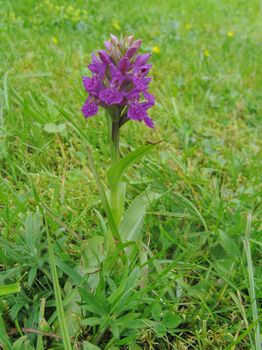
The first Northern Marsh Orchids (Dactylorhiza purpurella) were coming into flower, including this one which was growing in the lawn at the Lodge.
16th October 2011
In response to Linda's query (below), here is a picture of the wreck of the puffer Jennie as it was when I last saw it on 14th August 1994.
If you compare this picture with the third picture on a forum at OneGuyfromBarlick which was taken in 1988, you can see that there was some deterioration in the 6 years between the two pictures.
Fred thought there was almost nothing left by now, but there is a picture taken in 2010 which shows that there is at least something left.
16 October 2010
Isle of Eigg
Eigg is dominated by the Sgurr, seen below in a rather sombre mood.
While we were staying on Eigg, we were asked to look for Bladderwort (Utricularia sp.), a small aquatic plant which traps microscopic animals. The search took us to parts of the island that we might not have reached otherwise, including the central highland area which contains many lochs of different sizes.