Showing posts with label Isle of Soay. Show all posts

15 October 2011

Soay animals 2

In the summer we went back to the Isle of Soay, just south of Skye, where we had also been last year. We were looking forward to seeing how all the animals we met last year were doing.

Saffron, the lamb, has grown up and now has a lamb of her own.

We had to put up barricades at the doors to stop Arnold from coming into the house. He is now a full grown ram and could do a lot of damage if he got in.

The geese are now full grown.

There are two new additions - a mother goat and her kid.


In addition, there were bats living in the roof of the house where we were staying. One evening I went to an upstairs window to watch them emerge at dusk. Unfortunately one of the first to emerge somehow managed to come into the room by mistake and flew in circles around me. Later, although I had shut the upstairs door, we found it lying on the floor downstairs. Fortunately it was unharmed, and later flew off outside.


09 August 2010

Soay and Gavin Maxwell

Gavin Maxwell is perhaps best known for his book, "Ring of Bright Water," about his life with otters in a remote part of Scotland.

What is less known is that, after first looking at a map of Scotland during the war in 1940, and dreaming of buying an island there, he drew "an extra red ring round the Island of Soay," an island of which he knew nothing and had never visited. Three years later, he went to Soay and had a few hours ashore. Within a year or so, he had bought it.

Soon after, in 1944, he saw a basking shark for the first time. This excited him greatly, but mostly, it seems, with the desire to kill it. This experience led him to start up a shark fishing enterprise for the purpose of obtaining oil. He built a factory in the harbour as a base for this.

Below is the factory site seen from the other side of the harbour.

The store-house

The engine

View from the store-house window.

Rather fortunately for the sharks (which were not then legally protected, although they are now), the fishery was doomed to failure, and by 1949 it had ceased.

The story is told fully in Gavin Maxwell's book, "Harpoon at a Venture"

Further links:

Gavin Maxwell (Writer) 1914-1968

Gavin Maxwell (Wikipedia)

Gavin Maxwell (Undiscovered Scotland)

06 August 2010

Soay animals

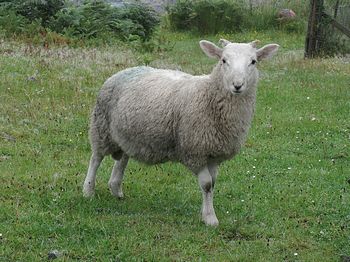
On Soay there are feral sheep, left over from former sheep farming. This year two lambs were abandoned by their mothers and had to be hand-reared.

Saffron had been abandoned at birth, and is still rather small for her age.

Arnold is much larger and quite a different character. He is inclined to butt people with his head if they don't look out.

The hens are always trying to get into the house, and tap on the window if they don't get attention.

The two geese are new arrivals, and growing fast. They are already able swimmers at this young age as they follow their owners when they go out in the dinghy.

Soay

Last week we spent some time on the island of Soay, which lies just to the south of Skye.

In the picture below, the Cuillins of Skye can be seen in the background.

In order to get to Soay, we went to Skye and our friends came in their own boat to fetch us as there is no regular ferry service. It is pretty isolated as the harbour is the other side of the island from where people live. It is only a short walk across, but not much good for carrying luggage or heavy goods so they have to walk across, which takes about half an hour, and bring the boat round, which takes about an hour. There is no jetty, so each stage has to be done by transferring to inflatables and landing on the beach. The crossing to Skye takes about an hour, and once there it is just a single-track road for about 12 miles. From September to March they expect to be more or less cut off, so they need to stock up supplies for 6 months just in case. There is no road or transport on the island and only 3 people living there plus a few houses used more or less as holiday cottages. Post comes about once a week, and once a month in winter.

There are many lochs on the island, and much of the rest is bog and heather moor.

Despite the island being low-lying, the coastline is quite spectacular.

The population used to be much larger. The school is now boarded up as there are no children.

The telephone box is no longer in use, except for storage.